
Question: These three jars came from ONE batch of tea. I took ONE teacup, put looseleaf rosehips in it, poured boiling water over it, and let it steep overnight. What could I have done to make three completely different colored teas? This was AFTER brewing. It’s something we can all do with our tea to maximize medicinal potency, but is often forgotten or skipped.
Scroll to the bottom for the answer.
Respiratory Resilience
A four-session virtual class on herbal support for lung health during wildfires and other mass air pollution events.
For accessibility information, please visit the course registration page.
Capitalist climate disaster is quite literally the air we breathe. As we all live through exposure to wildfire smoke and other air pollutants, how can we support one another in lung health?
Respiratory Resilience is a four-session virtual class on holistic support for the respiratory system with a focus on responding to poor air quality due to wildfire smoke. Class will be held on Mondays, 6pm - 8pm CST, September 21st, September 28th, October 5th, and October 12th. A portion of the proceeds from this class will go towards The Climate Mobilization, which provides peer-led support for BIPOC youth-led climate resilience projects.
Respiratory Resilience is a four-session virtual class on holistic support for the respiratory system with a focus on responding to poor air quality due to wildfire smoke. Class is Mondays, 6pm - 8pm CST, September 21st, September 28th, October 5th, and October 12th. Class is offered on a sliding scale. If you need a sliding scale price lower than the prices listed, please contact me to see if this is possible. Payment plans are available upon request. A portion of the proceeds from this class will go towards The Climate Mobilization, which provides peer-led support for BIPOC youth-led climate resilience projects.
For more details on Respiratory Resilience, click here.
Foundations of Herbalism
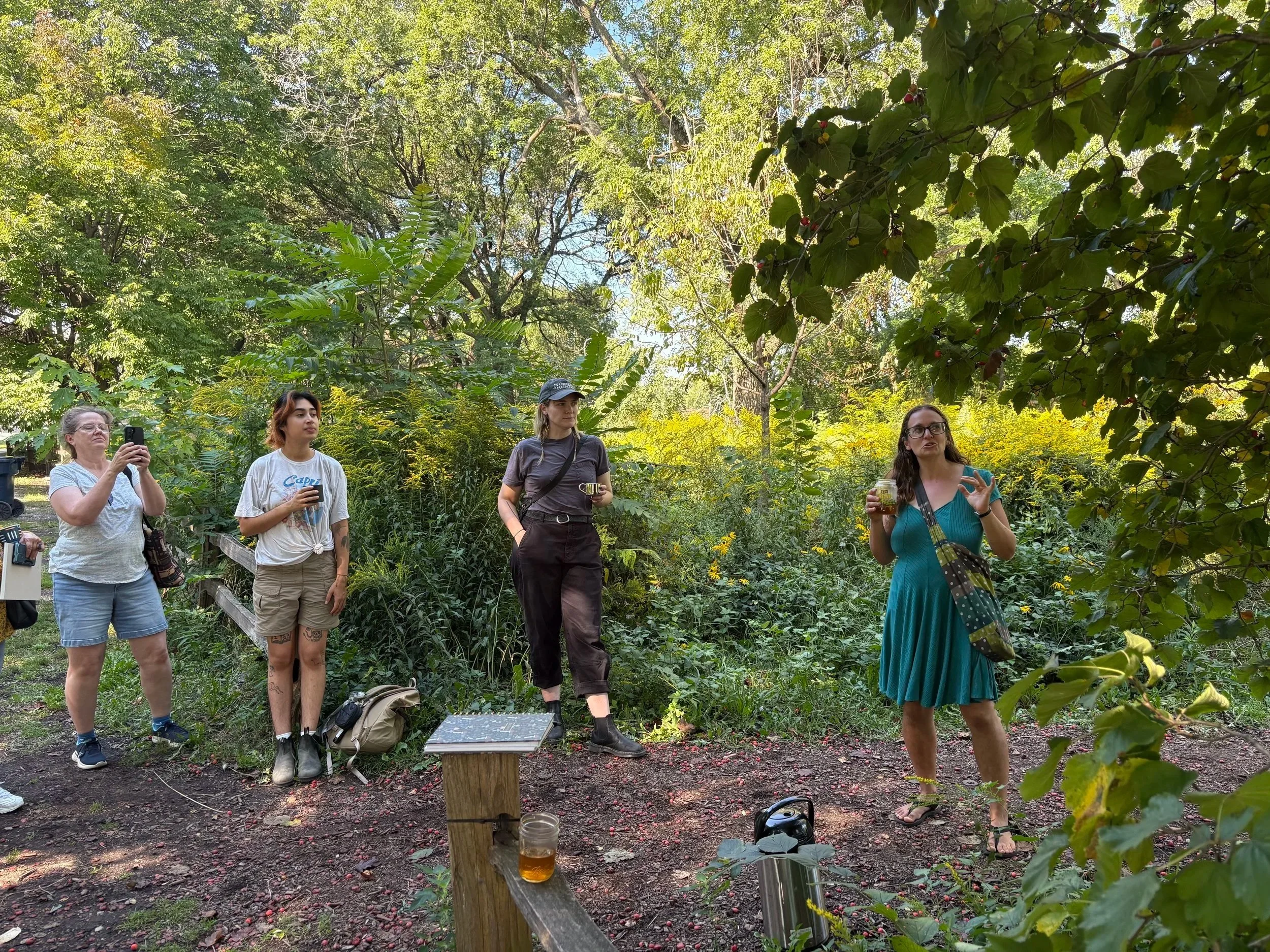
A four-week class to deepen your relationship with plant medicine. Sundays September 27th through October 18th.
For accessibility information, please visit the course registration page.
Gain an in-depth understanding of the medicinal properties of several herbs for common ailments
Learn the basics of medicine making: Make your own herbal teas, tinctures, vinegars, and syrups
Get to know the plants growing around us
A four-week class to deepen your relationship with plant medicine. Sundays, 2:30pm - 5:30pm, at Horner Park, Sept 27th through Oct 18th. There are a limited number of sliding scale spots. If you need a sliding scale price lower than the prices listed, please contact me to see if there are additional sliding scale slots available. Payment plans are available upon request.
So much packed into 4 weeks. 100% worth it. . . . I can’t wait to put what I’ve learned into my daily life!
-Past student
For more details on Foundations of Herbalism, click here.
A four-week class to deepen your relationship with plant medicine. Sundays, 2:30pm - 5:30pm, at Horner Park, Sept 27th through Oct 18th. There are a limited number of sliding scale spots. If you need a sliding scale price lower than the prices listed, please contact me to see if there are additional sliding scale slots available. Payment plans are available upon request.
Question: These three jars came from ONE batch of tea. I took ONE teacup, put looseleaf rosehips in it, poured boiling water over it, and let it steep overnight. What could I have done to make three completely different colored teas? This was AFTER brewing. It’s something we can all do with our tea to maximize medicinal potency, but is often forgotten or skipped.
Answer: This answer is in two parts I ended up with three finished products rather than two.
Part 1: Left versus middle. When the tea was brewed, the darker colored (and more potent) liquid settled at the bottom of the jar, while the tea at the top of the jar was much weaker and lighter colored. When I strained out the tea, I poured the top half first, and then the bottom half. The dramatic difference in color between the tea on the left and the tea in the middle is the “top pour” versus the “bottom pour.”
In terms of the implications for medicine-making, this phenomenon is good to keep in mind because it illustrates the physics of tea-brewing. Water with more medicinal components extracted into it is heavier. Therefore, many medicinal teas will settle with the more potent tea at the bottom of the container if they sit for awhile. There may be cases where this means you need to agitate or stir your medicine for optimal results. Also, if you have a tea that you don’t drink all of, if you the part you don’t finish is the bottom part, you are missing out on your strongest medicine.
Part 2: Middle versus right. As I said above, I originally poured the tea in two halves - the top pour and the bottom pour. The tea in the middle and the tea on the right are BOTH from the bottom pour. After I poured them, I divided the bottom pour into half again. Then I took the leftover herbs from the bottom of the jar (called the marc in herbal medicine), and squeezed them out into the jar on the right. Squeezing out the herbs made the difference between the middle jar and the jar on the right. While the left versus the middle is a bit more dramatic, there is still a visible and pronounced difference from the middle tea to the tea on the right.
Squeezing out your marc is SO IMPORTANT for extracting the most medicine from your herbs. Many people skip this step and they are losing out on the medicinal powers of their tea.